1940. Pierre
Schildneck Russian designer, who moved to France and then to Spain, painted
glass shots for “La florista de la Reina” (1940) and “Pepe Conde (1941) with
Enrique Alarcón as assistant. Schildneck used the technique of matte painting
he learned with Percy Day in France. He filmed the shot masking the areas which
he will paint over, and then paint the glass in his studio filming again the
glass on the original negative.

1942. Enrique Salva and a young Emilio Ruiz as his assistant, begun to paint in camera glass shots for art director Sigfredo Burmann in “El abanderado” They use the technique of ” glass shots” placing the glass in front of the camera, and painting the miniature with direct reference of the real stage, filming the painting with the actors at once.

1944. Pierre Schildneck as chief designer for the film “La torre de los siete jorobados” uses miniature models and matte paintings to recreate the underground city under Madrid. Only two small sections of the staircase leading down to the underground city were built; the rest was painted on glass by Schild.


1946. For
“Dulcinea” Enrique Salva and Emilio Ruiz paint a glass shot for the upper part
of sets and sky into the studio.

1948. Enrique Salva y Emilio Ruiz made several glass paintings for Sigfredo
Burmann in “Locura de amor”

1948 For the
Portuguese-Spanish coproduction Ines de Castro” Pierre Schild painted several
mattes to complete medieval sets.

1948. Art
director Alfonso de Lucas executed some glass shots for the film, “Don Juan de
Serrallonga” painting the second floor of the house and the sky.

1950. Pierre
Schildneck paints on glass the Gran Via street in Madrid for “El ultimo
caballo”.


1951. Enrique
Salvá and Emilio Ruiz painted several glass shots for Sigfredo Burmann in “Alba
de America”. ( At left is E.Salvá, at right E. Ruiz).


1952 Alfonso de
Lucas used a glass shot trick for the film “los ases buscan la paz” He pasted a
photo of Budapest and added some painted houses to match the foreground set.
1954. Art
director Juan Alberto Soler after working with Pierre Schild, painted some
glass shot for his films, like “El duende de Jerez”


1955. For the film “Marcelino pan y vino”, Pierre Schildneck uses the technique of matte painting to create the abbey on the hill.


1955. Emilio
Ruiz paints a cityscape in a glass sheet for “Cruz de Mayo” The glass breaks
and he repeats the paint on a sheet of a wood silhouette. This method he
perfected over the years, painting on cut out aluminum sheet.
1957. Enrique
Salvá travels to Mexico and paints mattes for “Cabo de Hornos” When back to
Spain he died in a traffic accident.

1958. Antonio
De Miguel, scenic painter, and assistant of art director Enrique Alarcón
executed several glass paintings for “¿Donde vas Alfonso XII?” like that ceiling for the Royal throne set

1959. Emilio
Ruiz paints glass shots for “The legions of Cleopatra” and “The last days
Pompeii” beginning a long term collaboration on Hispano-Italian
co-productions, mostly peplums, Spaghetti westerns, and war films.


1960 – Pierre
Schild retired from movies. After Enrique Salvá death a few years earlier,
Emilio Ruiz remains the only artist specialized in this technique. Although
some other scenic artists and art directors continue to paint on glass
occasionally.
1960 Juan
Alberto Soler painted some glass shots for “Gaudi” to recreate the construction
of some monuments and buildings designed for Architect Antonio Gaudi.

1961. Antonio de
Miguel painted a glass shot of old Peruvian City of Lima, for the film “Fray
Escoba”.

1963. Antonio De Miguel painted glass shots for art director Enrique
Alarcon for many films like “Rocío de la Mancha”

"Perseo
l’invincibile" (1963) Emilio Ruiz painted glasses for many "Sword and Sandal" movies, most of them filmed in Spain and Italy.

1965. Juan
Alberto as art director of Itali-Spanish film “Toto de Arabia” painted a glass
shot to complete the upper part of an Arabian style set.

1967. For the war film “Dalle Ardenne all’inferno” (1967) Emilio Ruiz painted several glass shots using his cut out aluminum technique.


1967. In
addition to his tasks as assistant art director, Antonio de Miguel painted a
glass shot for the film “Cotolay”

1973 . Emilio Ruiz painted miniatures on cut out aluminum for Ray Harryhausen´s “The Golden Voyage of Sinbad”.
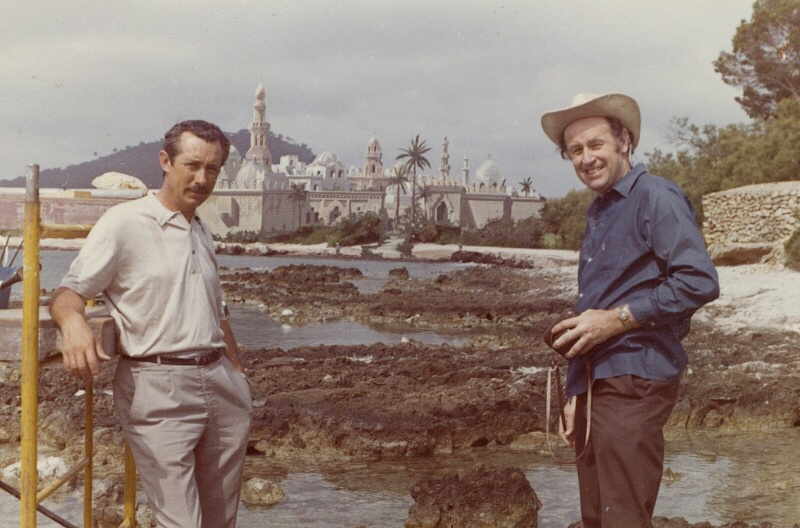


1977. Emilio
Ruiz began a fruitful collaboration with Juan Piquer Simon at “Journey to the
Center of the Earth.”

1980. Scenic
artist Julian Martin Benito, paint his first glass shot for the film
“Jalea real” beginning a career as a glass painter for over twenty years.

1981. Emilio
Ruiz make model miniatures and glass shots for “The Sea Devils” by Juan Piquer

1981. Francisco Prósper, after many years working as set constructor and miniature maker, started to paint on glass for the iranian film "Alqadisiya".

