17 nov 2014

Mattes go West

There are many Western films with matte paintings.  Some of them have plenty of matte artistry, like Gone with the Wind, but that large number of paintings in a Western film is not usual. Most frequently, you can find one or two mattes per film. I have chosen some of those titles on which I have just found one or two matte paintings. Unfortunately, most of these tricks are uncredited.

Ambush at Tomahawk Gap (1953) was produced by Columbia Pictures, with no FX credit.  Lawrence Butler was Head of the Effects Department at Columbia Pictures from the mid-40s to the late 60s, but I think they didn’t have a permanent matte painter at Columbia during those years.

The upper part of the frame is a painting showing the faraway village in the valley and the surrounding mountains.

The One and Only, genuine Family Band. (1968) The good thing about Disney Films is that matte paintings are always credited. This time Alan Maley was in charge of painting a distant view of Dakota.


Across the Wide Missouri ( 1951)   M.G.M. matte department under the supervision of Warren Newcombe. There are also several remarkable backdrop paintings that are enhanced with matte shots.


 I first thought those mountains and sky were matte shots, but it was a huge backdrop painting.


 Whispering Smith (1948) A Paramount Pictures film with Gordon Jennings and Farciot Edouard credited for Photographic effects. Jan Domela, the resident matte artist at Paramount, must be responsible for the painting.


The Wyoming Mail (1950) was produced by Universal Pictures with no credit for FX, as usual at Universal films before Albert Whitlock arrived from Disney.  The matte paintings should be the work of Russell Lawson.


 The upper part of that huge rock formation is a painting.  I noticed that because the shadows on the rock only change on the lower side. You can see the difference on those two frames from different shots.


Another Universal film, Cattle Drive (1951). This time with David S. Horsley credited for Special photography. Russell Lawson again uncredited for his matte paintings.
Only the centre area of the frame with the railroad on the plain is real. All the surrounding landscape is painted


The same set of a cavalry fort was used on many Universal films. The first one is from Column South (1953). The second is from War Arrow (1953). Both paintings are by Russell Lawson.


 For War Arrow (1953), the photographic effects were provided by Jack Rabin Company.  At that time, he used to team up with matte artist Irving Block, but Rabin also executed some matte paintings by himself, so either of them could have painted.
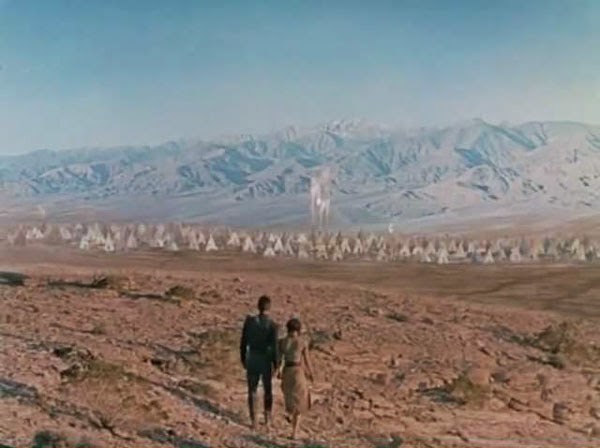


Western Union (1941) was a film produced by T.C.Fox, but strangely there are no credits for photographic effects. Fred Sersen was head of T.C.F. 's effects department; being a great matte artist himself, he had a team of matte painters that could have worked on that film, like Emile Kosa Jr., Ralph Hammeras,  Cliff Silsby, Max de Vegas, or Scotty Welborne.
 I found two beautiful matte paintings; the last one at the end of the film is a full painting with a tilt-up camera movement from the headstone to a glorious sky.


Springfield Rifles (1952) and The Command (1954) produced  by Warner Bros
For Warner films, it was usual not to find any VFX credit.  Lou Lichtenfeld was in charge of matte paintings from the early 50´s to the late 60´s, and probably he was responsible for those paintings. 


I cannot close that small article without mentioning the European westerns.  Most of them were Italian and Spanish productions during the 60´s.
Italian director, cinematographer, and tricks expert Mario Bava executed some in-camera glass shots on many films. He used to work with some Italian artists like  Amedeo Gigli, who painted  miniatures for him for almost a decade. Mostly for sword-and-sandal films. Bava also used to use cut-out photos, pasted on glass. I guess he used that technique on The Road to Fort Alamo (1964)


You just have to show around twenty extras on Indian costume on a medium wide shots and then for the wide shot  paint or paste photos of hundred Indians.


Spanish miniature artist Emilio Ruiz del Rio executed in-camera glass shots very often for westerns filmed in Spain.  Emilio usually painted on cut-out aluminium sheets instead of glass and made use of panoramic movement very often.

West village painted by Emilio Ruiz for Terrible Sheriff (1962) with a camera movement on the foreground painting.

For the film Charge of the Seven Cavalry (1965) he painted an Indian camp with the same technique that allows camera movement.  The painting was held by two trunks behind the actors.


Another matte shot with a horizontal camera movement that follows the carriage entering the set from Cannon from Cordoba (1970). The right part of the wall and the far-away landscape were painted on a cut out hold  on the foreground cactus.


12 oct 2014

Peter the Great (1986) Cliff Culley

Peter the Great is a TV mini-series produced by NBC, filmed in Russia and Austria, with an international cast and crew made up by professional like Italian director of photography Vittorio Storaro,  British and Russian art directors, John Blezard and Alexandr Popov, and with matte paintings by British artist  Cliff Culley.
The miniatures were provided by M&P Wollensack as it appears on the titles, but I haven’t found anything about that name.
Cliff Culley is one of the big names on the British matte painting History, he started very young as a matte apprentice at Pinewood 1946 under Bill Warrington head of FX department.  At that time was Les Bowie chief of matte painting department, who was succeeded by Albert Whitlock. Culley worked under Ellenshaw and Whitlock at some of the Disney movies filmed at Pinewood, like
The Sword and the Rose (1953)
When Whitlock went to the United States in 1954, Culley remained at Pinewood as a senior matte artist. He became chief of department and provided matte paintings, miniatures and optical tricks until middle 70´s when Pinewood matte department was closed down, he opened his own VFX house  Westbury Design and Optical with the assistance of his son Neil Culley as a matte photographer, providing visual effects tricks until his retirement at 1997.

 During all those years he had several matte painters working with him like Charles Stoneham at the '60s, Leigh Took from 1978 to 1985 to and Steven Begg at early '90s.

There is a big amount of matte paintings on Peter The Great and is highly probable that Culley had some matte assistant for that work.


Fireworks matted into the painting.


Photo of the painting for the Winter palace scene.

 More matte paintings for Peter the Great.


The miniatures were built M&P Wollensack


10 sept 2014

Painting the light.

Painting the light is possibly a paradox since we do not see the light, but what it illuminates. When we see rays of light, it is the dust in the air that we really see illuminated. These rays of light have been a recurring theme in the history of universal art.
The use of smoke on the set to show the light is common in the film industry.
Creating rays of light is not always possible, especially when filming on exteriors.  On many occasions, it was necessary for matte artists to paint those lines of light to produce dramatic effects, or simply to create spectacular images.


Let’s see some samples of those ray light paintings. 


The Crusades (1936)
Special effects: Gordon Jennings
Matte painting: Jan Domela


Garden of Allah (1936)
Matte painting supervisor: Jack Cosgrove
Matte cameraman: Clarence Slifer


La guerra gaucha (1942)
Matte painting: Ralph Papier


Inés de Castro (1944)
Matte painting: Pierre Schild


Captain Horatio Hornblower R.N. (1951)
Matte painting: Peter Ellenshaw


Kompozitor glinka (1952)
Matte shots designer:  L. Aleksandrovskaya/  I. Gordienko/  F. Krasny
Matte photographer: Grigoriy Ayzenberg


Dracula (1958)
Matte painting: Les Bowie.
Matte assistant ( Derek Meddings/ Ray Caple)


From the Terrace (1960)
Special photographic effects: Lb. Abbott
Matte painting: Emil Kosa Jr


The Birds (1963)
Matte painting: Albert Whitlock
Matte photography: Roswell Hoffmann


The Gnome-mobile (1967)
Special effects: Eustace Lycett/ Robert A. Mattey
Matte painting: Peter Ellenshaw


Candleshoe (1977)
Matte painting: Cliff Culley


The Blue Brothers (1980)
Special visual effects: Albert Whitlock
Matte artist: Syd Dutton
Matte camera: Bill Taylor


The Ewok Adventure (1984)
Matte painting and camera: Jim Danforth


The Adventures of  Baron Munchausen (1988)
Matte painting: Doug Ferris
Matte camera: John Grant


Frank Ordaz

 Biography:  Extract from his website.http://ordazart.com/ From age 10, Ordaz studied with famed California master artist and renowned art i...