Today’s
article is dedicated to Spanish artist Emilio Ruiz del Río.
He started to work on films at 1942 as scenic painter and soon became assistant
of art director and glass painter Enrique Salvá. Emilio specialized in
camera glass painting and cut-out paintings, a variant of the glass shot
technique in which he cut out the painted element on a thin aluminium sheet,
avoiding the glass reflections and the fragility and difficulty of moving with
huge glass sheets. During the sixties and
seventies, he started to add some three-dimensional elements to his paintings, and in the eighties
he mastered the foreground miniatures technique on films like Conan (1982) or
Dune(1984). He made wide use of both
techniques, sometimes mixed until his death in 2007.
Emilio Ruiz(on the left) during the filming of one of his cut-out paintings.

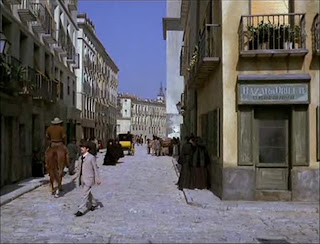
For the Spanish
TV series Fortunata y Jacinta (1979), he was recruited to make some in-camera
tricks to enhance the sets.
 On that occasion, he used the technique of aluminium cut-out paintings.


This TV series recreates 19th-century Madrid with a lot of authenticity. That means the miniature paintings should be invisible, and they were.


This TV series recreates 19th-century Madrid with a lot of authenticity. That means the miniature paintings should be invisible, and they were.


The Emilio’s paintings
matched perfectly the sets making it impossible to detect the trick.


No hay comentarios:
Publicar un comentario