3 dic 2018

Albert Jullion

Biography:

Albert Jullion was born in Calais, France, in 1909. He moved to England, where he worked at Gaumont and Gainsborough Studios during the 30, and 40 as art director and background and glass shot painter. In 1948, he left Gainsborough to work as art director for British MGM on “Idol of Paris”. In the early 50s, he moved to Shepperton Studios as a senior matte painter under Wally Veevers. Died in 1962 (age 52) in Middlesex, England, UK


Filmography:

- Don't Panic Chaps (1959) (special effects)
A full matte painting created by Albert Jullion, who painted it while working in the matte painting department at Shepperton Studios under the supervision of Wally Veevers for the film Don't Panic Chaps.

- Blue Murder at St. Trinian’s (1957) (special effects) (as A. Jullion)


- No Highway (1951) (scenic artist)
- Idol of Paris (1948) (Art Director)
- The Magic Bow (1946) (special effects) (as A. Jullion)

- Caravan (1946) (background)
- Madonna of the Seven Moons (1945) (background)
- Millions Like Us (1943) (scenic artist)
- The Lady Vanishes (1938) (assistant set designer)
- Secret Agent (1936) (set dresser)
- Sabotage (1936) (Art Director)
- The 39 Steps (1935) (Art Director)
- Rome Express (1932) (assistant art director)

Alan Maley

Alan Maley was born in England and attended Reigate College of Art. He went to work in the British film industry, where he served a five-year apprenticeship, beginning as an assistant sign painter.

 During the '50s, he used to work as a freelance scenic and matte artist at Shepperton and Pinewood Studios. He made some matte work for Wally Veevers during the sixties. Among his favorite shots was the final scene in Dr. Strangelove, a Stanley Kubrick film in which actor Slim Pickens rides a nuclear bomb to his doom. Maley's career included associations with film figures such as John Huston, on Moulin Rouge and Beat the Devil. Maley was at the scenic and matte painting unit under Peter Ellenshaw for the Disney movie In Search of Castaways (1962) filmed at Pinewood Studios.  Ellenshaw was very happy with him, and some years later Maley went to the USA to work at the Disney matte department under Ellenshaw in 1966.  He became head of the matte team in the seventies until his retirement from Disney in 1975.  He went back shortly to matte paintings in the '80s to be matte painting supervisor at ILM. He was also known as a painter and exhibited impressionistic oils and Victorian-era scenes. He established Past Impressions, a business in Belvedere, to sell lithographs of the latter pieces.

Alan Maley working on a painting from Raiders of the Lost Ark.


Filmography.

- Raiders of the Lost Ark (1981) (ILM matte painting supervisor)
- Dragonslayer (1981) (ILM matte painting supervisor)
- The Spy Who Loved Me (1977) (special optical effects)

- Escape to Witch Mountain (1975)(DISNEY matte artist)
- Island at the Top of the World, The (1974) (DISNEY matte artist)
- Return of the Big Cat (1974) (TV) (DISNEY matte artist)
- The World’s Greatest Athlete (1973)(DISNEY matte artist)
- Mystery on the castle of Dracula(1972)(DISNEY matte artist)
- Biscuit Eater, The (1972) (DISNEY title designer)
- Snowball Express (1972) (DISNEY matte artist)
- Scandalous John (1971) (DISNEY matte artist)
- Barefoot Executive, The (1971) (DISNEY matte artist)
- Bedknobs and Broomsticks (1971) (DISNEY matte artist)
- Wild Country, The (1971) (DISNEY matte artist)
- Boatniks, The (1970) (DISNEY matte artist)
- Computer Wore Tennis Shoes, The (1970) (DISNEY title designer)
- King of the Grizzlies (1970)(DISNEY matte artist)
- Rascal (1969)(DISNEY matte artist)
- Love Bug, The (1969) (DISNEY special photographic effects)
- Horse in the Gray Flannel Suit, The (1968) (DISNEY Matte artist, title designer)
- The One and Only, Genuine, Original Family Band (1968) (DISNEY matte artist)
- Never a Dull Moment (1968)(DISNEY matte artist)
- The Happiest Millionaire (1967) (DISNEY matte artist, title designer)

- Dr. Strangelove or: How I Learned to Stop Worrying and Love the Bomb (1964)(matte painter)
- Becket (1964)(matte painter)
- In Search of the Castaways (1962)(scenic artist)
- Very Important Person (1961) (scenic artist)
- Make Mine Mink (1960)(scenic artist)
- Too Many Crooks (1959)(scenic artist)
- No Highway (1951) (Assistant scenic artist)


1 ago 2018

Four Italian Foreground miniatures.

I have not written anything new for a while, and this time is not about matte painting, but about a very similar perspective trick.
These small epic films also are known as "peplums" used very often perspective trick with foreground miniatures and matte glass paintings. Most of the Italian art directors of that time were very well aware of the use of model tricks.
I enjoy watching these films, mostly for artistic works, set building, miniatures, matte painting, monsters, and fantasy creatures. I have found four  Italian  "Sword and sandal " films that used the same real location, enhanced with foreground hanging miniatures

The real location is  Palazzo della Civiltagrave del Lavoro, Rome. 


The first two films were directed by Pietro Francisci, who had full knowledge of these perspective tricks.
1. La regina di Saba /The Queen of Sheba  (1952)
A huge model miniature of an impressive temple cleverly filmed as a foreground miniature. That big model must be supported from the upper part and left side with a horizontal support. The man on the chariot on the right doesn´t move so he can hide the vertical support of the miniature.  The shadow of the model can be seen on the foreground floor.


2. Ercole Sfida Sansone / Hercules, Samson & Ulysses (1963)
Another beautiful foreground miniature perfectly matched with the perspective of the first floor of the arch facade. 

3. Messalina  Venere imperatrice (1960,Vittorio Cottafavi)
This time is a frontal hanging miniature facade of a temple that covers the real building completely.  The miniature was again hung from the upper part.


 4. Giants of Thessaly / I giganti della  Tessaglia (1960 Ricardo Freda)
Another hanging miniature of a temple facade, with an open door from which we can see one of the arches of the original building.  

5. I dieci gladiatori (1963, Gianfranco Parolini). On this occasion, they used the location as it really is.


19 jun 2017

Small daring paintings: Emilio Ruiz del Rio.

He just needed one stick to hold the sheet of cut-out aluminum, and he was ready to paint. Then, something to cover the support stick with a rock, a bush, a pole, or just another aluminum piece, and make it invisible by painting the background landscape.

Emilio Ruiz was very often asked to add some elements in a real location. It could be a castle, a church,  a house, or whatever.  In his early years, he used the traditional glass shot technique. This is very suitable for filming inside a studio, but going to a location with a huge sheet of glass is not an easy task, not cheap either for the low-budget films he used to work at. He started to use a very simple method to avoid this problem: painting on a sheet of cut-out metal, thin aluminum.  Depending on the painted element size, he used one or two fastening points. Usually one vertical and another horizontal (figure1), but sometimes the painted element was so small he could be attached with one single support that could be vertical or horizontal (figure 2, 3). He hid these supports using foreground elements like a pole, truck, rock, bush, etc. During the sixties and seventies, he became an expert on this kind of small trick, and he got so much confidence that sometimes he does not even bother to hide the support with any foreground element; he just enlarged the aluminum covering the support stick and painted it with the background colors, making it invisible (figure 4). With so many years of experience, Emilio Ruiz knew how far he could get with those tricks. 


So, if you are watching a European co-production in the sixties or seventies, and suspect something in the background could be a painting if there is a pole, a rock, or anything similar in the foreground,  it is very probable you are watching an Emilio Ruiz  "in-camera" miniature painting. 

Talking about daring tricks, this is one of the boldest " in-camera" paintings of Emilio Ruiz. For the film  Special Mission Lady Chaplin (1966, Alberto De Martino), he painted a building over a hill with invisible vertical support in the middle of the frame.


Why am I so sure? Well, I have seen the film, and during a second the trick is exposed when a yellow car moves on the road that crosses the frame horizontally and goes behind the painting just for a second.
The film is on YouTube, so you can see the trick at the beginning of the film during the title credits at 0: 36

.  


Scheherazade (1963, Pierre Gaspard-Huit)


A bullet for Rommel ( 1969, Leon Klimovsky)
They got only four real tanks, and the director wanted a column of them. At the central part of the frame,  there is a miniature cut-out painting that hides a small structure with a miniature landscape with a road and small models of tanks moving down the path. 


Kill them and come back alone (1969, Enzo Castellari)
Both views of that ruined church are foreground painted miniatures.


Eagles over London (1969, Enzo Castellari)

A Reason to Live, a Reason to Die (1972, Tonino Valerii)


Zorro ( 1975, Duccio Tessari)


The  Inglorious Bastards (1978, Enzo Castellari)


There are many more; that´s just a glimpse of Emilio Ruiz´s art. 


 In the late seventies Emilio Ruiz started to make also foreground miniatures.  Sometimes he mixed both techniques,  tridimensional miniatures and cut-out painting elements in the same shot, depending on the film budget.  Building foreground miniatures required the assistance of model makers, which made it more expensive than just a painting, but with the advantage that they could be shot at any time of the day. While working for  Dino De Laurentiis for several years ( Conan the barbarian, Dune, Conan the Destroyer, Red Sonja, Taipan), he was able to do wonderful foreground miniatures. 

Foreground miniature for Conan the Destroyer (1984). The two vertical sticks are temporary supports that were removed before filming. 


12 may 2016

The North Star (1943)


That Lewis Mileston Drama War film  have many  wonderful  miniatures and matte paintings shots, as many of the Sam Goldwyn films, with Clarence Slifer and Ray Binger credited for the Photographic  effects.  In praise of the impressive visual and artistic imagery on that film we shouldn't forget the name of production designer  William Cameron Menzies who is credited as associate producer.

Matte camera operator Clarence   Slifer was head of photographic effect unit at many films produced by  David Oselznick during the 30´s and 40´s, but also share his duties with Sam Goldwyn films.   Ray Binger was  another  special effects  cinematographer who worked also very often for Sam Goldwyn productions.


Although there is not matte painter credited at "The North Star" Clarence Sliffer  used to work  frequently with the same  group of artists as Jack Cosgrove , Albert Simpson, Jack Shaw, and Fitch Fulton.   I can only guess that  the  excellent matte work on that films was made by some of those artist. 

Some wonderful miniature shots made for the war scenes.


22 dic 2015

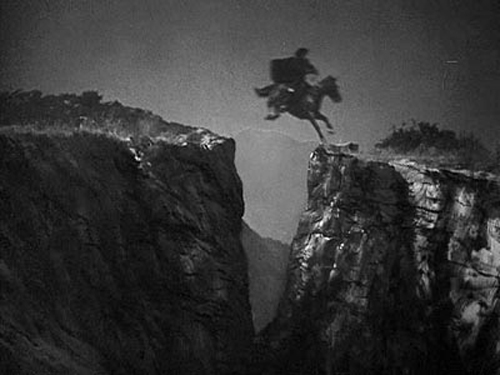
Jumping the Chasm

  
There are many iconic subjects that depict the art of matte paintings.  Probably a castle or fortress on the top of a hill could be the most popular. Apart from other all time matte subjects, the jumping of a huge spectacular chasm has been without a doubt one of the frequent topic under request for matte painters.
We’ve seen people jumping gorges since the silent era. That’s a small overview of some of those great exciting moments of magic on the screen.


 1929    Tide of empire  MGM.
Warren Newcombe was working at MGM matte department since 1925, I guess he must be involved on that shot. Maybe also Ferdinand Pinney Earle who was painting mattes for MGM during the 20´S.


1935. She   RKO Pictures
Vernon L. Walker as Photographic effects supervisor, and Linwood B. Dunn as optical effects, the matte paintings probably were done by Mario Larrinaga and Byron Crabbe

1936 Santa Fe bound . 
Produced by Reliable Pictures Corporation, there is not  VFX credit of any kind. And I don’t have any idea who could have painted that.


 1944. Ali Babá and the Forty thieves. Universal Pictures
John Fulton was credited as photographic effects. Russell Lawson was head of Universal matte department at that time, and probably with John De Cuir as matte painter assistant.


1948.  Man from Texas   VFX Jack Rabin.
Jack Rabin got credit as matte effects. That film is  before he tamed up with  Irving Block to supply VFX for low budget films. Rabin worked  in several FX department from  Selznick,  Warner bros and T.C. Fox dong miniatures, opticals and matte paintings.  After joined with  Block, most of the matte painting work was done by his partner.


1953.     Rob Roy: The highland Rogue. Disney production.
Matte paintings by Peter Ellenshaw made at  Elstree Studios in London with Albert Whitlock as matte assistant.


1954 . Passion. RKO. Pictures
No FX credit but probably Albert Maxwell Simpson, who was working for RKO during those years.


1957. Zorro rides into terror  (TV series Zorro)    Disney
Peter Ellenshaw was in charge of the matte paintings.


1957. Zorro secret passage  (TV series Zorro)  Disney
Again  mattes by Peter Ellenshaw.


1962.     Taras Bulba. United artist . 
Although it was Russell Lawson credited on that film, and he was responsible for most of the matte paintings on that show, Albert Whitclock was commissioned by Howard Anderson Company to execute the paintings for the gorge horse jumping.


 1964    Cheyenne Autumn  Warner. Bros
No FX credit on that film, but  probably  the matte work was by Lou Lichtenfield head of matte paintings at Warner Studios.


1972. Evil Roy Slade Universal Pictures
Albert Whitlock credited as head of matte department at Universal Studios.


1986    Solarbabies  VFX by Boos film Studios.
Veteran matte artist  Mat Yuricich was supervisor of  matte paintings with Michelle Moen as matte assistant.


 1994.       On deadly ground  
Roco Gioffre, former Yuricich assistant, was responsible for those matte paintings.


There are much more matte paintings on that jumping issue.  That was just a representative small selection.

Frank Ordaz

 Biography:  Extract from his website.http://ordazart.com/ From age 10, Ordaz studied with famed California master artist and renowned art i...